The bird does not become free when the door opens. It becomes free the moment it remembers it was never meant for the cage.
Sit with that line for a second before I say anything else. Because everything I’m about to write hangs on it.
The Word Has Been Hollowed Out
Sovereignty is a word in trouble.
The wellness industry took it and turned it into permission to make whatever choice was easiest. The empowerment crowd made it about brand voice and confident posture. The political right took half of it and called it personal responsibility. The political left took half of it and called it bodily autonomy. Both halves are true. Neither half is the whole thing.
Sovereignty is the condition of being unowned.
Not unaffected. Not free of consequence. Not in some bubble where the world doesn’t get to push on you. Unowned. Whatever else is happening, the thing at the center of you — the part that decides what’s true and what matters — doesn’t belong to anyone but you. Not to a system. Not to a partner. Not to a parent who’s been dead 20 years. Not to a story you’ve been telling yourself since you were 9.
Most of us don’t have it. Most of us trade it away in pieces, daily, without noticing. And most of us have never been told that the trading is happening, let alone that there’s another way.
Sovereignty is the condition of being unowned.
The Sentence That Cracked Me Open
I was in my 30s, going through a breakup that I was, frankly, relieved about. We’d been a bad fit for a while. I should have ended it sooner.
But that didn’t stop me from doing what people do when something ends, which is making it everyone else’s fault. She was the problem. Her family was the problem. The things she’d said and the things she hadn’t. The way she’d misread me. The way I’d been misunderstood. I had a complete map of why my pain belonged to other people, and I was building it out in detail, daily, with anyone who’d listen.
A friend of mine, Barb, listened for as long as she could and then she said the thing that ultimately changed me.
“Dakota, as long as you play the victim role, you will never own your power.”
I didn’t take it well at first. Of course I didn’t. The whole structure I’d built that month was designed precisely to keep that sentence from settling into my spine. I was right and she was wrong. I had been wronged and the wrong needed to be witnessed.
But Barb didn’t take it back. And after she said it, the sentence sat in me. It sat for weeks. Months, really. It sat through the rest of the breakup and into the slow, mortifying realization that I’d been doing this in some form my whole life. With this partner. With my family. With my work. With every situation where something didn’t go the way I wanted, I had a fully developed theory about why someone else was responsible.
It took a few years to work through what she’d handed me. The work was simple in shape and brutal in practice. Every time I felt the pull to blame, I had to stop and ask: what’s my role in this play? What did I actually need that I wasn’t asking for? What did I agree to that I’m now resenting? What boundary did I not set that I’m now mad about?
The answers were rarely flattering. But the longer I sat with them, the more I noticed something I hadn’t expected. I felt stronger. Not harder. Stronger. The self-loathing that had been my background music for years started thinning out. I liked myself more. I trusted myself more. I stopped needing other people to verify what I already knew.
That was the first time I touched sovereignty as a felt experience rather than a concept. It came through the door of personal accountability, which is not the door I expected, and not the door anyone advertises.
How I Teach It Now
That experience changed how I teach.
The first thing I tell every student who comes to work with me is this: question everything I present to you. Run it through your own body. See if it lands as true for you. I will offer interpretations of what your experience might mean, but the final word belongs to you.
I’ll give you an example I use a lot. Oracle decks. Most people pull a card and immediately reach for the little book that came in the box. Don’t do that. Pull the card. Look at the image. What do you feel? What symbols speak to you? What does this card say in conversation with the question you asked? Sit with all of that first. Then, if you want, glance at the book to see if anything in it deepens what you already know. Fun fact, I used to buy oracle decks how some people buy candy bars at the checkout lane, you know you shouldn’t but just can’t resist … when people come to retreats, they marvel at all the decks I have but then question why none of them have the books. First thing I do when I get a deck is hide the book in a closet.
The book is not the oracle. You are the oracle. The book is a footnote (in a closet).
I tell them never to consult a website, a book, or another person to get the interpretation of something they’ve personally seen or encountered. Other people’s interpretations come through the lens of their own life. Their lens is not yours. Their lens cannot see what you saw, or understand it in the way that only your life experiences give you meaning.
This sounds simple. It is not. Every woman I’ve taught has had to fight to do this, because every woman I’ve taught was raised to outsource. We were taught that the authority is always somewhere else. The expert. The book. The man at the front of the room. We were taught that the body’s “no” was rude, that intuition was unreliable, that the proper move was always to defer.
The work of sovereignty is the slow undoing of that training. It starts with one card. One question. One time you trust your body before you check the book.
What Sovereignty Is, on the Inside
Sovereignty is a posture the body holds when it has stopped outsourcing.
Outsourcing your worth to whoever’s giving or withholding approval that week. Outsourcing your decisions to whoever sounds most certain in the room. Outsourcing your interpretation of your own experience to people who weren’t there. Outsourcing your story about who you are to the family system that named you wrong when you were 6.
Most women I work with are deeply outsourced. They don’t know it because the outsourcing started so early it just feels like reality. They check in with their partner before they know what they think. They check in with their mother before they know what they want. They check in with their friend group before they know what they feel. By the time they get to me they’re usually in their 40s and starting to suspect that there might be a self underneath all the checking-in, but they can’t quite locate her.
The sovereignty work is the work of bringing her home.
It looks ordinary. It looks like sitting at your kitchen table and writing down what you actually want from your life without consulting anyone. Like feeling an emotion and letting it be the emotion you’re having instead of immediately running it through the filter of what you’re supposed to be feeling. Like saying no to something you’d usually say yes to, just to find out what happens to your body when you do.
The body keeps score on this. It knows when you’ve handed yourself over and it knows when you’ve taken yourself back. The signal is small at first. A loosening. A breath that goes deeper than you expected. A quiet realization, in some ordinary moment, that nobody else’s opinion of you is currently in the room.
That’s sovereignty, in its quietest form. It’s also the foundation. Everything else builds on it.
The Cage Is Real
Now we widen the lens.
The work I just described doesn’t happen in a neutral environment. It happens inside cages. Real ones. Built by specific hands.
I’m a woman. The fight for sovereignty as a woman is older than most of us realize, and the version of that fight we know is younger than most of us realize. For most of human prehistory, before about 3,000 BCE, European cultures appear to have been more egalitarian and goddess-centered than what came after. The archaeology, especially the work of Marija Gimbutas, points to a long stretch of agrarian, matrilineal societies in what she called Old Europe. Whether they were truly matriarchal in the modern sense is contested, but the shift away from female-centered religion toward warrior, patriarchal, hierarchical structures is documented. It happened in waves of conquest, cultural pressure, and eventually religious consolidation by Rome and the Church. The last 4,000 to 5,000 years, the period most of us assume is “history,” is actually the back end of a much longer story in which women’s authority was less constrained.
What this means is the patriarchal cage isn’t a permanent feature of human life. It’s a recent overlay. The bones underneath are older.
And in the meantime, the cage we live inside is real. The right to own property, to vote, to refuse a marriage, to refuse pregnancy, to walk down a street unaccompanied without it being seen as an invitation, to keep our own name, to have a checking account, to leave a man who was hitting us. All of those rights, in my own grandmother’s lifetime, were either fully denied or actively contested. They are still contested in much of the world and increasingly contested again here.
I’m gay. In the 1980s, when I was coming up, I could be fired for it, denied housing for it, turned away from my partner’s hospital bedside for it, and have no recourse. I’m not speaking hypothetically. I lost a job at Limited Inc. for being gay. The founder of that company, Les Wexner, would later become a central figure in the Epstein files. Make of that what you will. I couldn’t marry the women I loved. I couldn’t inherit from them without a fight. The state I lived in had laws on the books that made my existence a misdemeanor depending on which judge was reading them. This was my early adulthood.
I’m a shaman. Animist. Mystic. The labels themselves trigger discomfort in a culture that decided 400 years ago that this kind of knowing was either superstition or witchcraft. People in my lineage have been burned for less than what I do publicly. Even now, the social cost of being openly mystical in the wrong room is real.
My mother-in-law, who is Mormon, asked me once what I did for a living. I said, “I’m a shamanic teacher and practitioner.” She nodded politely and changed the subject. A while later she came back, curious, and said, “May I ask what exactly does a Satanic Teacher teach?”
And I love her dearly. I’m telling that story with love. I think she may have actually misheard me. But I also think the slip wasn’t entirely accidental. The word shamanic is close enough to the word satanic that for a lot of people in this country, the two have collapsed into the same category. Anything outside the Abrahamic frame reads as dangerous. Witch, shaman, mystic, healer, devil. Same drawer.
The cage isn’t only about gender and orientation and lineage. It’s structural. The system is built to punish anyone who takes a path it didn’t lay out. I’m a self-employed woman running my own work, which means my health insurance costs more than my mortgage and offers less than what a mid-level corporate job would cover for free. The system rewards conformity and taxes the rest of us at a rate that’s quiet enough not to look like punishment but functions as exactly that. Independent farmers, independent artists, independent healers, independent teachers, independent thinkers, all paying the surcharge for refusing to fit.
This is real. The cage is real. I’m not interested in pretending it isn’t, and I’m not interested in spiritual frameworks that ask women to bypass it.
Why the Inside Work Has to Come First
There’s something I’ve come to know, slowly, over years of doing this with myself and with the women I teach.
You cannot fight a system from a foundation of weakness.
You cannot meet a structural cage with a self that’s still asking the cage’s permission to be real. You cannot dismantle anything, externally, from a place of internal collapse. You can try. People do. It produces a particular kind of activism that runs on rage and burns out within 5 years and leaves a wake of broken people who started out wanting to help.
The only sustainable fight comes from women who’ve done the inside work first. Who know who they are without external verification. Who have rooted themselves in something the cage cannot reach. Who have, in the language I keep coming back to, remembered they were never meant for the cage.
That’s why Barb’s sentence mattered. That’s why the personal accountability door is the door I keep pointing women toward, even when they want me to point them toward something more dramatic. Because the woman who knows her own role in her own life can do anything. The woman who’s still outsourcing her worth to the people who built the cage can rattle the bars, but she can’t get out, and she can’t help anyone else get out.
The inside work isn’t a substitute for the outside work. It’s the precondition.
A woman rooted in her own sovereignty meets the system from the ground. She doesn’t react. She responds. She doesn’t get pulled into every fight that comes for her. She picks her ground. She lasts. That kind of woman, multiplied, is what changes anything.
The Bird, Again
I’ll come back to where I started.
The bird does not become free when the door opens. It becomes free the moment it remembers it was never meant for the cage.
The door opens when laws are changed. It opens when we vote, whether at the polls or with our checkbooks. It opens with rulings handed down from judges we elected to open those doors. Generations of women had to fight to win them. We’re still fighting. And we are not yet done.
But the law cannot remember for a bird that thinks the cage is the world. The bird has to remember first. She has to know, in her body, that she has wings, that the sky is hers, that the cage was always a story someone else was telling.
The remembering is the inside work. The flying is what comes after.
A lot of women I meet and work with have technically left the cage. The metaphorical door has been opened. They have the career, the marriage of their choice, the autonomy we didn’t have before. And yet they are still living as if the cage walls were the only defining boundary that said “this is where the world ends.” Still asking permission. Still staying small in rooms they paid to be in. Still building lives shaped by what they were told they were allowed.
The door was opened. But the bird still had a tether strapped to her foot.
The freedom she was promised hasn’t arrived. The door can be opened for you, but you have to cut the tether yourself. And you have to remember that the cage was never meant to keep you safe. It was built to keep you compliant. When you remember this, you will release the cage altogether.
The cage was never meant to keep you safe. It was built to keep you compliant.
Sovereignty is the act of remembering.
What I’m Offering
So this whole question of remembering, of becoming what you actually are underneath the cage, is the work my year-long program is built on. The Wheel of the Cailleach moves through 4 seasonal arcs, and the arc that opens this June is called Dawn. The theme is sacred feminine leadership. The work is about embodying your power so fully that you become the kind of woman who can actually meet what’s in front of us.
Before that opens, I’m offering a 27-day live ritual experience called SOVEREIGN. Built around 9 ancient goddesses, one every 3 days, with the song titles spelling out the word itself. It’s $44 and it opens May 22. The free tier gives you the first goddess, the Cailleach, to taste the work. The $44 you’d spend on SOVEREIGN counts toward enrollment in the Dawn Arc when it opens.
I’m being honest about the structure because I respect you enough not to bury it. The sequence is: SOVEREIGN as the doorway. The Dawn Arc as the year-long embodiment. The remembering, then the building of the body that can carry what the remembering reveals. Each can be done independently of the other, or dive into the deeper end of the pool and walk both.
If any of this lands, the door is open.
Sign up for SOVEREIGN · Free or Live Round →
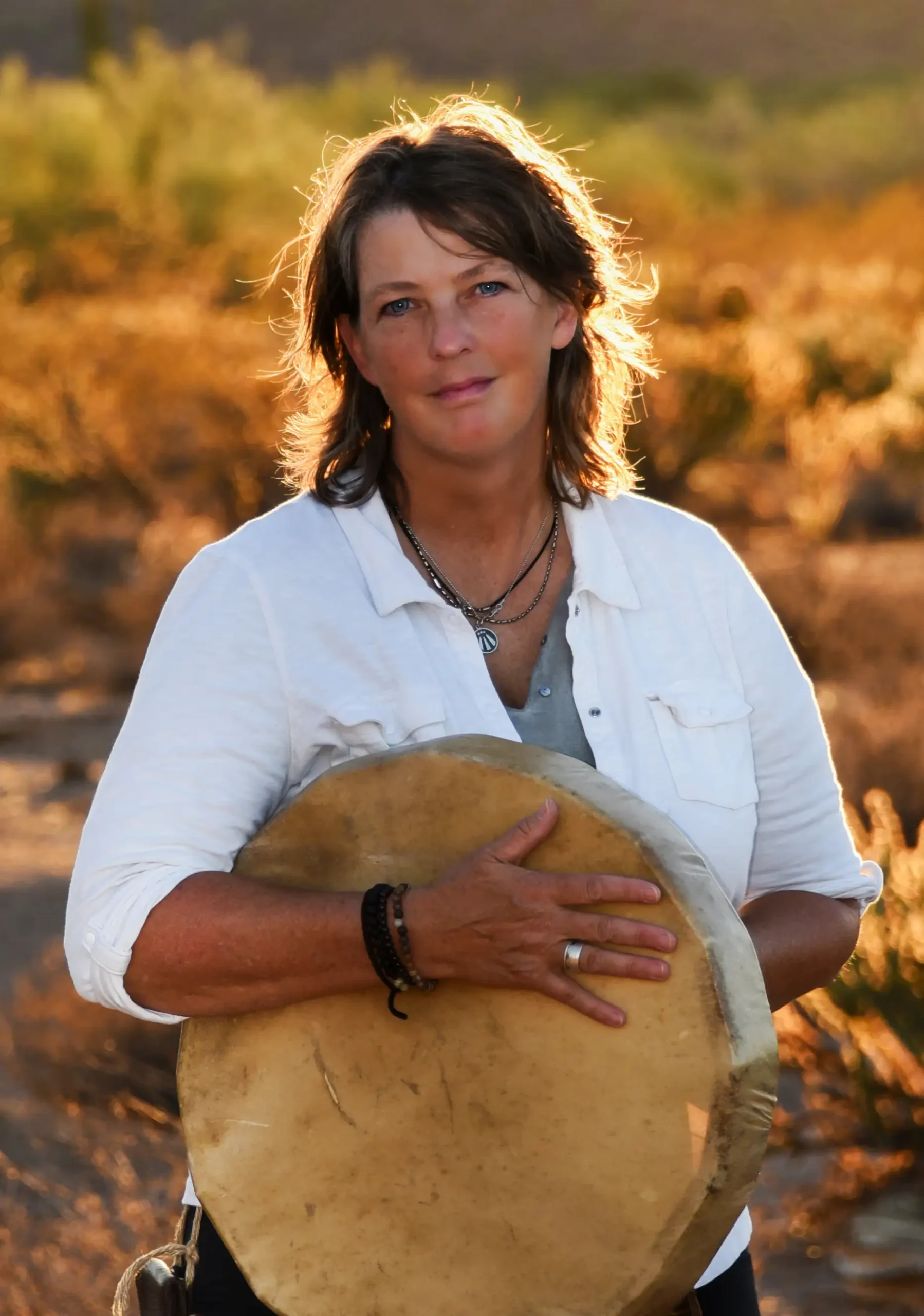
Dakota Earth Cloud Walker is a shamanic teacher, lyricist, and creative director. She’s a certified master ritualist trained through Linda Star Wolf’s Shamanic Breathwork lineage, and she runs The Wheel of the Cailleach, a year-long sacred feminine program. She writes from a small place in the woods where the candles get lit most evenings.